Energy-Saving Automated Window System
The Problem
Traditional HVAC systems often lead to excessive energy consumption due to inefficient ventilation practices. Our senior design project aimed to reduce this waste by creating an automated window system that intelligently opens or closes windows based on real-time weather conditions and user-defined preferences.
Project Objectives
- Optimize indoor air quality and temperature without over-reliance on HVAC systems
- Use real-time weather data to inform window control logic
- Incorporate user preferences through a web interface
- Develop a modular, scalable control system with safety features
Design & Implementation
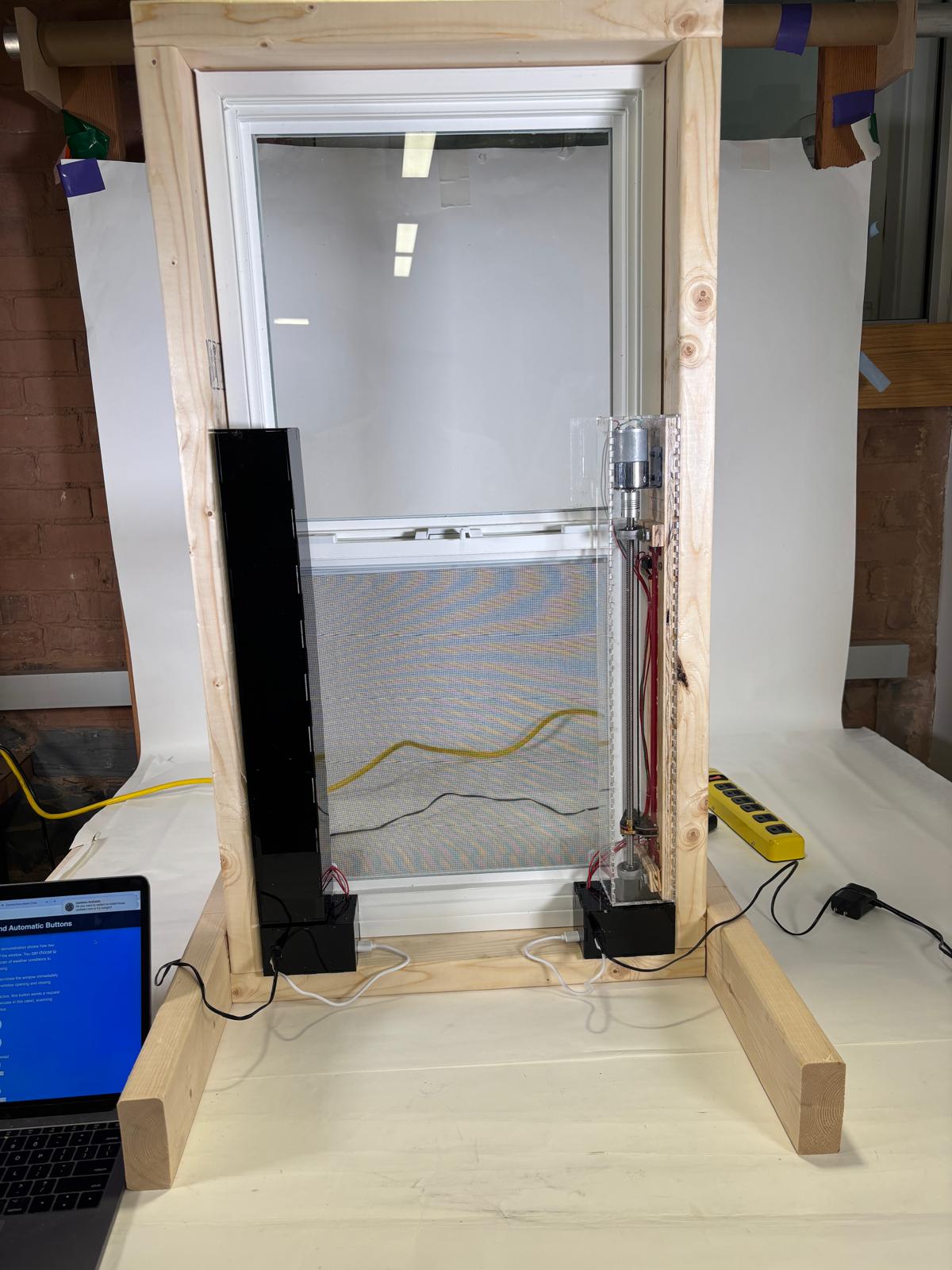
- Hardware: Included linear actuators, temperature and humidity sensors, and a microcontroller (Raspberry Pi)
- Software: Python was used to develop the control logic and decision matrix
- Web Interface: Users can adjust preferences and see current system status through a dashboard built with HTML/CSS/JavaScript
- APIs: Integrated weather data API (e.g., OpenWeatherMap) to monitor outside temperature, humidity, and wind conditions
System Workflow
The system continuously collects weather data and user preferences. It evaluates this input against a decision matrix that determines whether the window should open or close. Safety checks prevent window movement during rain or high wind speeds. Users are notified of system actions through the interface.
Challenges & Solutions
- Challenge: Making accurate decisions with noisy or fluctuating data
- Solution: Applied averaging techniques and created adjustable sensitivity thresholds
- Challenge: Designing a real-time dashboard with minimal delay
- Solution: Used lightweight front-end libraries and optimized API calls
Media
Impact & Takeaways
This project demonstrated the practical value of automation in energy savings. It was a successful integration of mechanical design, environmental sensing, control logic, and user interface development. I gained hands-on experience in hardware-software integration and reinforced my understanding of sustainable system design.
Project Links
- Final Report: Download PDF
- GitHub Repository: View Code on GitHub